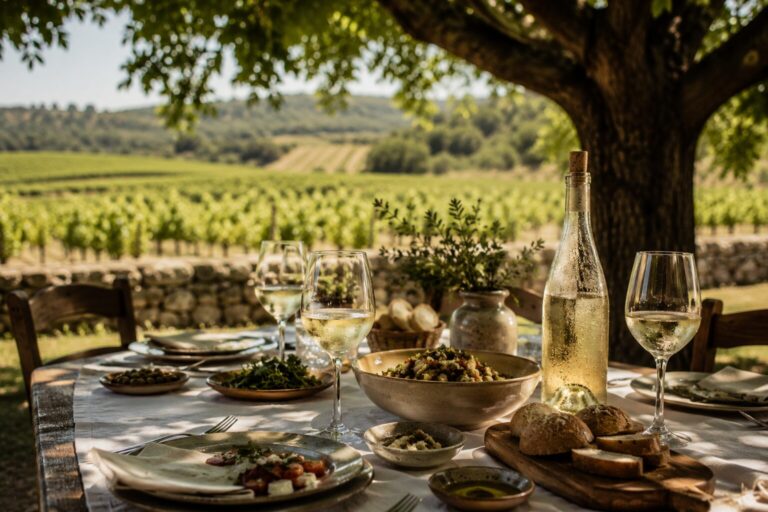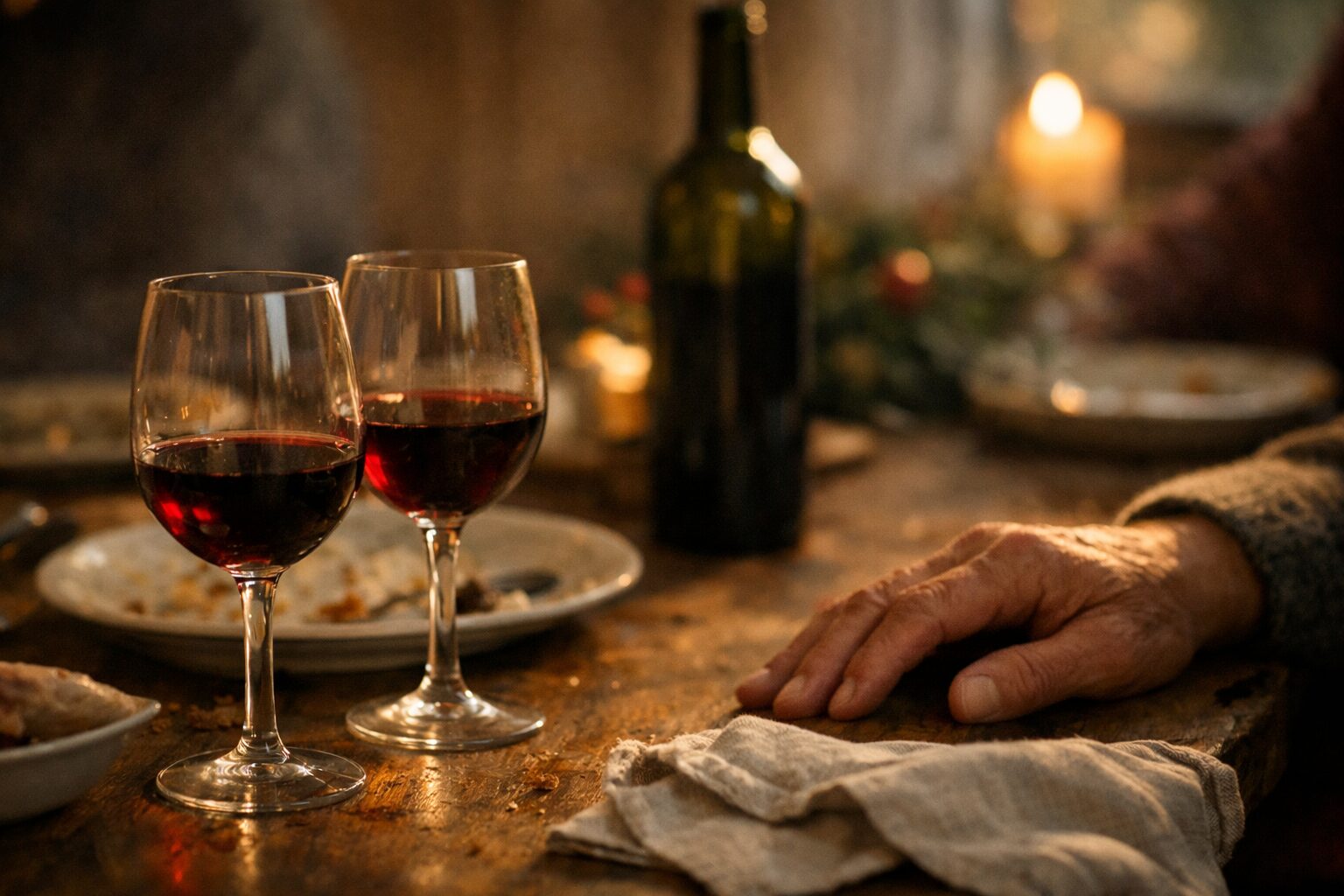
The Role of Wine at Christmas: Ritual, Time and Human Connection
Christmas as a ritual, not a commercial event
There is a quiet difference between living Christmas and merely getting through Christmas.
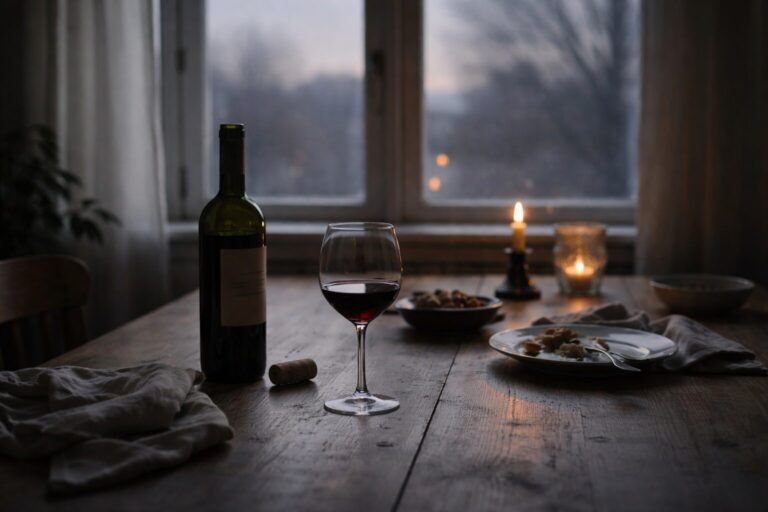
The first happens when time slows down. When the house smells of food made in advance. When the table is laid with care, not to “look nice” but to welcome. The second is Christmas turned into a calendar: queues, wrapping paper, noise, and a kind of collective urgency to “get everything right”.
This is where wine often comes in through the wrong door.
Instead of being a thread that ties together people, memories and conversations, it becomes an object for display. Instead of being part of the ritual, quiet, alive and human, it becomes a status signal, an extra to impress. And when that happens, wine stops being culture and becomes decoration.
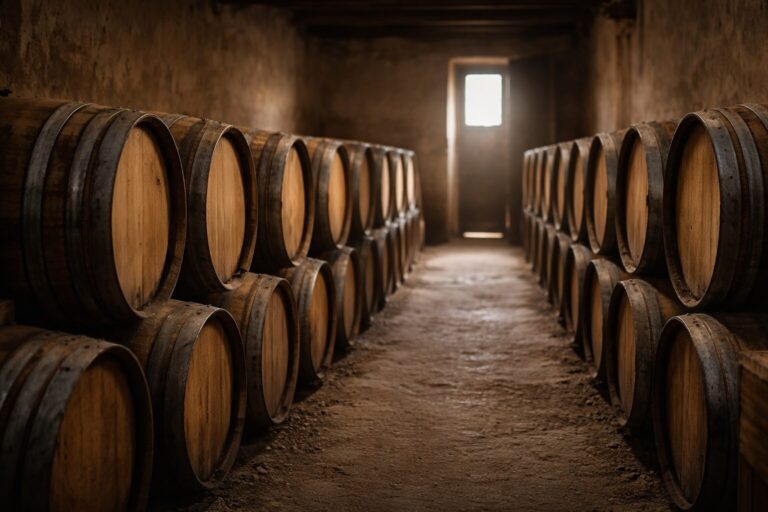
I like wine because it has time inside it. Time in the vineyard, time in the cellar, time spent waiting. And Christmas, when it is real, is also this: time. Not clock time, but human time, the kind in which a pause is worth more than a schedule.
So when I talk about wine at Christmas, I do not think about “which is best”. I think about a more honest question: what is wine for, on this night?
If the answer is “to connect people”, we are on the right track. If the answer is “to show something off”, we are losing the essential, and, ironically, losing the pleasure too.
This is where the idea of drinkfulness comes in. It is not drinking little out of obligation. It is drinking with intention. Choosing wine as part of a moment, not as the centre of the stage.
Wine at the Christmas table: tradition, time and silence
At some Christmas tables the wine is barely mentioned. To me, that is a compliment.
Here, wine does not need a speech. It is there as it was on our grandparents’ table, and on theirs before them. The bottle is opened, the wine is poured, and suddenly the conversation changes temperature. People put their phones down. Bodies relax. There is a small silence at the first sip: not a technical silence, but a human one, like someone recognising they have arrived.
Christmas has that ability: to restore what the year has worn down. And wine, when it has the right place in the ritual, helps with exactly that, because it invites presence. It invites the here and now.
Technically, this makes sense. In moderate amounts and with food, alcohol works as a social facilitator: it eases tension, quiets anxiety, brings emotional tones closer. But what matters is not the chemistry on its own. It is the whole: food, light, people, history, and wine as a bridge.
The mistake is trying to turn that bridge into a stage.
When a wine is chosen to be talked about out loud, it often starts competing with the dinner and with the people. And at Christmas, competing is always a way of losing. The best Christmas table is not the one that shows off. It is the one that welcomes. Wine should be that: a form of welcome.
There is one more thing you learn with the years: wine at Christmas does not need to shout. Quite the opposite. The wines that shine most on these days are often those with balance, freshness and clarity. Wines that accompany without dominating, that leave the centre to the food and the people.
That is why I like the image of wine as silence. Not the silence of absence, but the silence of something that is right and does not need proving.
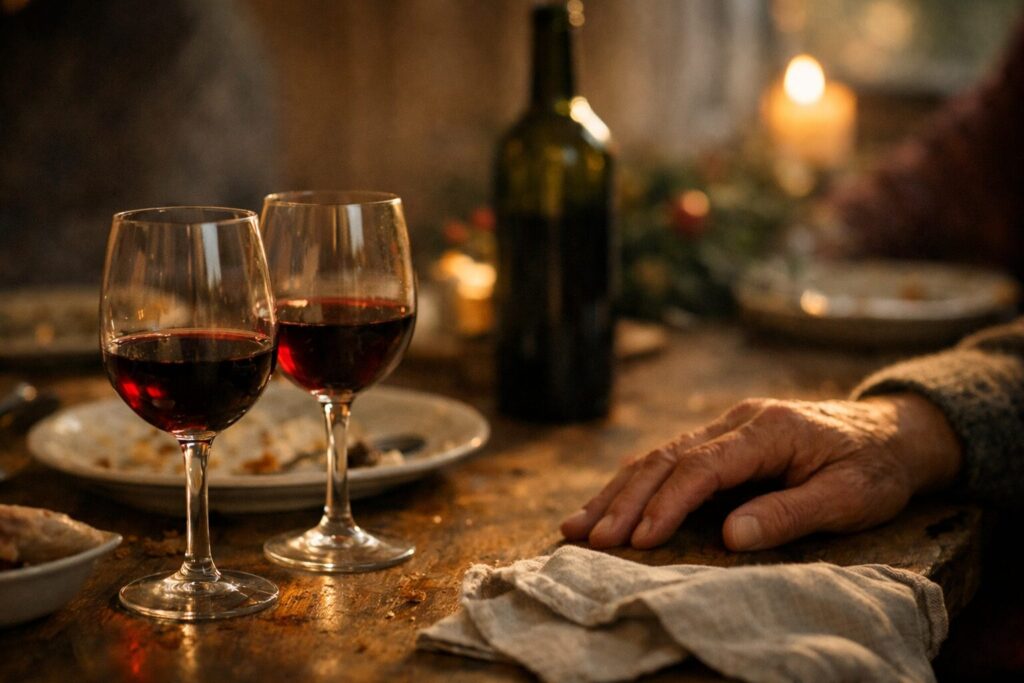
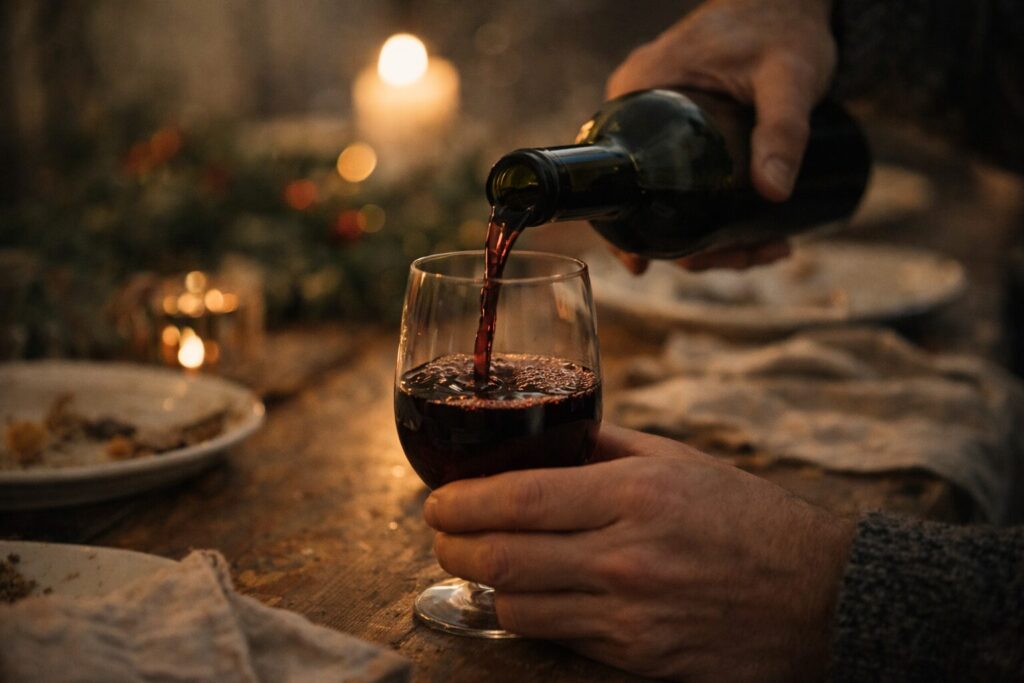
When time slows down, wine stops being an object and becomes company.
The common mistake: choosing wines to impress
There is a pattern that repeats every year: someone wants to “get the Christmas wine right”, and confuses getting it right with impressing.
The intention is good. Nobody wants to get it wrong at a moment so full of meaning. But the logic of status is treacherous: it makes us choose for other people, not for the table. And when we choose so as “not to be judged”, we stop choosing freely.
Trying to impress usually leads to three mistakes.
The first is excess: too many bottles, too many labels, too much anxiety. As if abundance could cure the fear of not measuring up. In the end, people drink more than they should and remember less of what they lived.
The second is mismatch: wines that are very powerful, very marked, very “demonstrative”, that take space from the food and make the conversation heavier than it needed to be. Some reds are magnificent, but on a night of many starters, different dishes and family rhythms, they can make everything slower, denser and harder.
The third is theatre: talking about wine as if it were an exam, correcting someone else’s glass, turning every bottle into a lecture. I understand: wine can be fascinating. But at Christmas the greater fascination should be the people at the table, not the vocabulary. And there is an uncomfortable truth here: when wine becomes a tool of self-assertion, it stops being shared. If the aim is “to prove I know”, the wine becomes about me. And Christmas, to be worth anything, needs to be about us.
That is why drinkfulness is such a simple and such a difficult answer: it asks for humility. It asks us to step out of the centre and put the moment there instead. It asks us to choose wines that serve connection, not ego.
Getting wine right at Christmas: choosing wines that connect people
When I think about wine and sharing, I think of a wine that brings people closer. A wine that asks for no performance from the glass, no knowledge from the reader, no approval from anyone. A wine that connects people has some very concrete qualities.
The first is drinkability: not in the sense of being “simple”, but in the sense of being hospitable. Some wines are technically deep and transparent at the same time. They do not make the palate fight. They invite.
The second is versatility at the table. Christmas is plural: there is salt cod, there are roasts, starters, desserts, dishes that come back every year and dishes that turn up by surprise. Choosing wines that accompany without imposing is choosing peace. And peace, at Christmas, is a real luxury.
The third is the ability to start a conversation without dominating it. A wine can be the start of a story (“do you remember that night?”, “do you remember Grandad pouring it like this?”, “do you remember the Christmas the power went out?”) rather than the subject that hijacks the table.
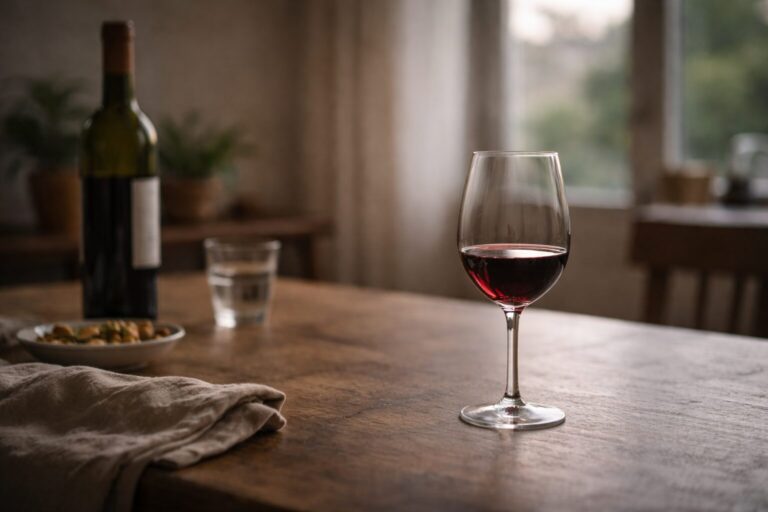
There is one gesture I find particularly beautiful: when someone pours a glass and says only “taste”. No speech. No sales pitch. And then lets the other person react however they like. That is respect. It is freedom. It is sharing. And this is where wine stops being an object and becomes a ritual again. Because the ritual is not the bottle. The ritual is attention. Pouring with care. Noticing whether the other person wants more or wants to stop. Keeping water on the table as part of the same dignity. Understanding that drinking with awareness is not moralism. It is human elegance.
In the end, choosing wine to connect people is choosing wine as a language of affection. And the language of affection at Christmas is always quiet. It has nothing to prove.
Fewer bottles, more intention
There is an idea I defend with growing conviction: fewer bottles, more intention.
Christmas, because it is rare and symbolic, tempts us into excess. But excess is not the same as emotional abundance. Sometimes it is the opposite: it is noise. And noise does not create memory; it creates fatigue.
Intention starts before the bottle is opened. It starts with choosing a wine and accepting that it does not need to please everyone. It needs to serve the table. It starts with deciding that the wine will accompany the food and the conversation, not replace either. It starts with looking after the pace: pour slowly, eat, pause, talk, come back. In practice, this changes everything.
When we drink in a hurry, the body is left behind. The alcohol arrives before presence does. When we drink with food and with pauses, the wine stays where it belongs: in the place of pleasure and connection, not of escape. And here is a point many people avoid saying out loud, though it is central if we are talking about culture: wine is not an endurance test. It is a form of civilisation.
Christmas is a chance to restore that civilisation at home. To show younger people that wine is not “freedom without limits” but a pleasure with form, context and measure. To show older people that we do not have to repeat old habits: we can choose better without losing tradition.
Drinkfulness at Christmas can be something simple: open fewer bottles, pour smaller glasses, drink more slowly, alternate with water, and above all talk more than you comment on the wine.
In the end, what remains is not the list of bottles. It is what happened between the people.
Wine at Christmas as a memory between generations
There is something about Christmas that moves me: it is one of the few moments when the generations sit at the same table, with their differences, their wounds, their affections, their unfinished stories. And wine, quietly, works as an emotional archive.
Some people remember Christmas by the food. Some by the smell of the house. And some by a glass poured by someone who is no longer here. Not because it was an “expensive” wine, but because it was that wine, in that setting, poured by those hands. Wine can do that: carry a whole moment in a single detail.
That is why I dislike the idea of wine as ostentation at Christmas. Ostentation is sterile. It puts down no roots. And Christmas is roots. It is family, even when the family is imperfect. It is trying, for one night at least, to honour what came before and look after what comes next.
If we want to talk about wine culture in Portugal, there is one essential point: culture is not made only in tastings and restaurants. It is made at home. At the table. In the way adults drink in front of the young. In how naturally someone says “that’s enough” without embarrassment. In the way we drink slowly and listen.
And there is a gesture I wish were more common: telling the story of a wine without turning it into a lesson. Saying, for example: “this wine reminds me of your grandfather”, or “we always open this one at this time of year”, or “this is for the bacalhau, because the bacalhau deserves respect”. Small sentences that build identity without a sales pitch.
In the end, wine becomes a memory between generations not because it is rare, but because it is lived with intention.
The real Christmas toast
The real Christmas toast is not to the wine. It is to the people.
Wine is only the means. An old, imperfect, deeply human means that teaches us something simple: the best things in life need time. And they need presence. If I could leave one idea for this Christmas, it would be this: choose your wine the way you would choose an important word. Not for how strongly it sounds, but for how truly it fits.
Wine at Christmas can be a ritual. It can be a good silence. It can be sharing. It can be a reminder that the table is a sacred place: not religious, but human.
And if there is drinkfulness on this night, it will not be in the quantity or the price. It will be in the form: in the care, the pace, the measure, the quiet joy.
Which wine will you open this Christmas, and with whom?
Further reading
- Drink Less, Drink Better: Trend, Necessity or a Return to Essentials?: the cultural shift in how we drink wine, and why it matters to drink with awareness and intention.
- Winter in the Vineyard: When Nothing Happens, and Everything Is Being Decided (Casca Wines Journal): why the silence and dormancy of the vineyard are an essential part of the cycle that leads to the wine in the glass.